
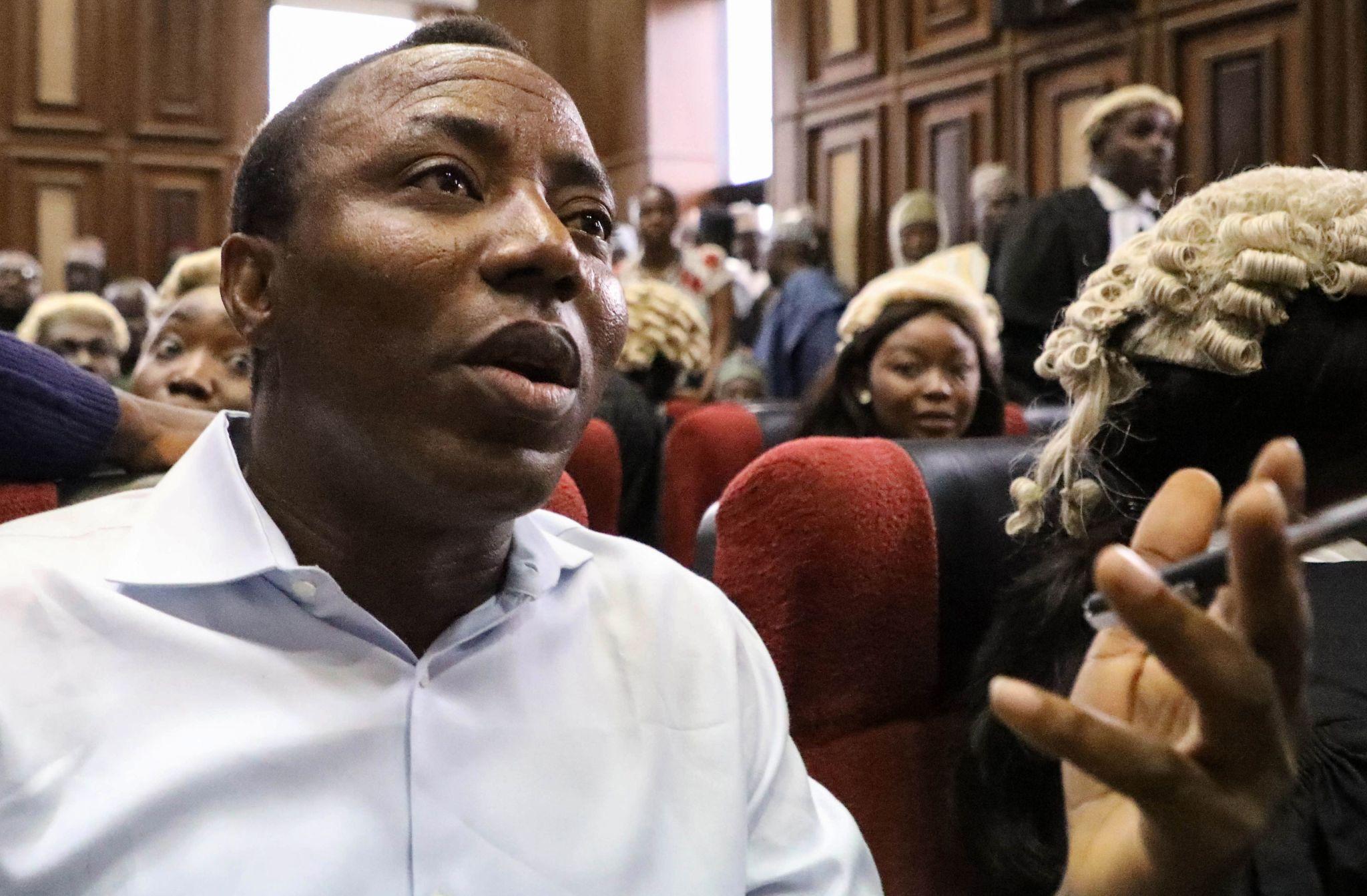
Omoyele Sowore has been remanded at Kuje Correctional Centre over a cybercrime and defamation case linked to his social media posts. Here are the legal questions and constitutional issues raised by the case.
CLAIM 1: “The charges stem from X posts calling Tinubu a criminal”
PARTIALLY TRUE — BUT INCOMPLETE AND MISLEADING
The posts were made on both X (formerly Twitter) and Facebook, not X alone. The charges allege offences under Sections 24(1)(b) and 24(2)(a), (b), and (c) of the Cybercrimes Act, 2024. The posts, dated August 25, 2025, were made in response to President Tinubu’s claim in Brazil that his administration had ended corruption in Nigeria.
Furthermore, the original charge was not simply two counts. The DSS filed a five-count criminal charge (FHC/ABJ/CR/484/2025) accusing Sowore of using his official X handle to post defamatory content about President Tinubu. Count two alleges the same message was posted on Facebook on August 26, 2025. Counts three and four accuse him of publishing defamatory material contrary to Section 375 of the Criminal Code, and count five alleges he published false information harming the reputation of the president contrary to Section 59 of the Criminal Code Act. Only after amendments in December 2025 was the charge reduced to two counts, with X and Meta dropped as defendants.
CLAIM 2: That Sowore’s post was “knowingly false”
THE DSS CLAIM IS DISPUTED AND LEGALLY WEAK
The prosecution’s core argument — that Sowore’s statement was “false” — is itself factually contested. The video the DSS played in court as evidence actually showed President Tinubu telling Brazilians there was “no more corruption” under his regime. In other words, Tinubu did say what Sowore said he said. Calling a president who claims to have ended corruption “a criminal” is political opinion, not a factual falsehood that can be objectively proven false. The DSS claiming this constitutes a criminal falsehood is legally extraordinary. SERAP and Amnesty International have argued that the right to freedom of expression applies to all kinds of information and ideas, including those that may shock, offend or disturb, irrespective of the truth or falsehood of the content, and that Nigerian courts and regional human rights courts have consistently held that politicians should expect far greater criticism than ordinary individuals.
CLAIM 3: That the DSS is an appropriate body to prosecute this case
FALSE — AND CONSTITUTIONALLY IRREGULAR
The DSS (Department of State Services) is an intelligence and internal security agency — not a law enforcement or prosecutorial authority in the conventional sense. Its role is to gather domestic intelligence, not to prosecute citizens for tweets. Sowore pointed out that America’s presidential protection service has never filed lawsuits against citizens who criticise presidents.
The DSS also went further than filing a case. It demanded that X Inc. and Meta Platforms Inc. ban Sowore’s accounts and remove the posts. The security agency also wrote to Sowore asking him to delete the posts from all platforms. Non-compliance with the request led to the charges. This is a pattern of using state security machinery to suppress political speech — a function no democratic state grants to its intelligence services.
CLAIM 4: That Sowore’s absence on June 16 was an act of disobedience
FALSE — THIS IS WHERE THE GREATEST INJUSTICE LIES
This is the most critical factual distortion in the entire narrative. The prosecution framed Sowore’s absence as deliberate obstruction. The facts tell a different story entirely.
On the date set for the ruling on the recusal application, Sowore was present in court, but the court did not sit. Thereafter, Sowore addressed a formal letter to the Deputy Chief Registrar of the Federal High Court seeking clarification on the next date, which was reportedly minuted and transmitted to the judge. And yet, the court proceeded to revoke bail and issue a bench warrant the following day upon the oral application made by DSS counsel.
A Nigerian legal commentator posed the critical question directly: How does a defendant who attended court, where the court did not sit, and who subsequently sought clarification through the Registry, become the basis for a revocation of bail and issuance of a bench warrant without a clear finding of disobedience, abscondment or breach of bail conditions?
Furthermore, when Sowore’s new lawyer appeared on June 22, Senior Advocate of Nigeria Adeyinka Patrick Olumide-Fusika apologised to the court for the defendant’s absence, explaining that he had instructed Sowore to travel to Lagos for consultations and proper briefing on the case. The absence was on legal advice — not defiance.
CLAIM 5: That the recusal application was simply a delay tactic
DISPUTED — THE GROUNDS WERE SERIOUS AND DOCUMENTED
Justice Umar’s court dismissed the recusal bid, calling it an afterthought and an attempt to delay proceedings. However, the grounds Sowore cited were concrete and publicly documented. The incident referenced occurred on 16 March 2026. The lawyer drew the ire of the judge when he raised his voice while making submissions in court. Justice Umar then ordered Sowore’s lawyer to “come out” of the bar area of the courtroom “and kneel down.” Other lawyers quickly prevailed upon the judge to forgive him.
This is not a trivial allegation. Ordering a defence counsel to kneel in open court is an act of extraordinary judicial aggression that strikes at the independence of the bar and the defendant’s right to representation. Under Section 36(1) of the 1999 Constitution, every person charged with a criminal offence is entitled to a fair hearing. The principle that justice must not only be done but be seen to be done — established in the UK case R v Sussex Justices, ex parte McCarthy (1924), cited by Sowore’s own defence — is also enshrined in Nigerian jurisprudence. Sowore cited that authority and Supreme Court decisions on judicial bias and fair hearing, contending that the circumstances created a reasonable apprehension of bias sufficient to warrant the judge’s recusal.
CLAIM 6: That the Cybercrimes Act validly covers this kind of speech
FALSE UNDER REGIONAL LAW — AND CONTESTED UNDER NIGERIAN LAW
This is perhaps the most consequential legal fact in the entire case. The law being used to prosecute Sowore has already been declared invalid by a superior regional court.
The ECOWAS Court ruled that it was unconstitutional to prosecute anyone on the grounds of “insulting” or “annoying” people online. The court ordered the Nigerian government to repeal Section 24 of the Act because it is inconsistent with the African Charter on Human and Peoples’ Rights as well as the International Covenant on Civil and Political Rights. Nigeria is a state party to both.
Nigeria amended the Act in 2024 — removing words like “annoyance” and “insult” — but critics argue the core problem remains. SERAP noted that the provisions of the Cybercrimes Amendment Act 2024, including Section 24, are inconsistent with Section 39 of the Nigerian Constitution 1999 and the African Charter on Human and Peoples’ Rights, and that the ECOWAS Court had already ordered the Federal Government to amend Section 24.
Nigeria, having signed and ratified the African Charter, is under treaty obligation to comply. Prosecuting Sowore under the same section the ECOWAS Court condemned is therefore not just questionable — it is a violation of Nigeria’s international legal obligations.
CLAIM 7: That the legal team withdrawal was voluntary
TRUE — BUT CONTEXT IS IMPORTANT
Following a judicial directive for daily trial hearings in early June 2026, Sowore’s legal team withdrew from the case, citing the humiliation his lawyers faced. The withdrawal was not arbitrary — it was directly connected to the kneeling incident and what lawyers described as persistent hostility from the bench. Forcing a defendant to effectively self-represent in a serious criminal trial by creating conditions lawyers find intolerable is itself a threat to the right to a fair hearing under Section 36(6)(c) of the 1999 Constitution, which guarantees a defendant the right to legal representation of their own choice.
WHAT IS CONFIRMED TRUE
- Sowore did make the posts in August 2025 calling Tinubu a criminal, and has never denied doing so.
- Sowore insisted that his criticism was part of his constitutional right to hold leaders accountable and vowed not to delete the posts.
- He was arraigned on December 2, 2025 and pleaded not guilty.
- The court did reject his no-case submission in May 2026 and ruled a prima facie case existed.
- He was remanded at Kuje Correctional Centre on June 22, 2026 until June 24.
- A new SAN (Senior Advocate) appeared for him on June 22 and apologised for his absence.
SUMMARY VERDICT
The DSS case against Sowore rests on a legally battered statute that a regional court ordered Nigeria to repeal, is being driven by an intelligence agency rather than an independent prosecutor, targets what is clearly political opinion rather than verifiable falsehood, and has been handled by a trial court whose conduct — including ordering defence counsel to kneel — raises serious fair hearing questions under Sections 36 and 39 of the 1999 Nigerian Constitution, Article 9 of the African Charter on Human and Peoples’ Rights, and Article 19 of the International Covenant on Civil and Political Rights. The bail revocation over an absence that was communicated and excused compounds these violations materially.